
What Actually Happens to Scrapped Cars?
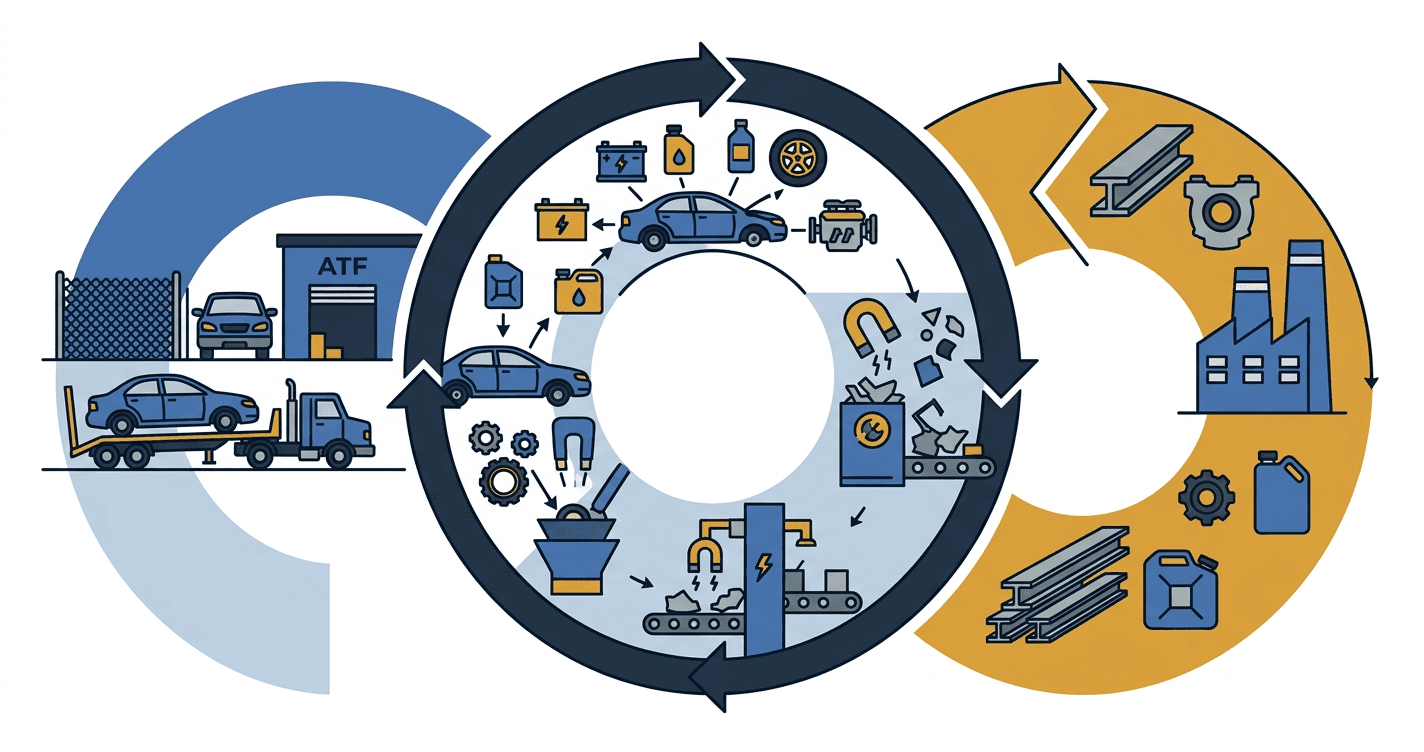
The mental image of a scrap car usually ends the same way: a cube of crushed metal. It's a satisfying image, but it significantly underestimates what actually happens at a modern Authorised Treatment Facility. Before anything gets crushed, a lot needs to happen.
Step 1: Depollution
Before anything else, every end-of-life vehicle must be depolluted. This is a legal requirement under the End of Life Vehicles (ELV) Regulations 2003. All hazardous fluids and components must be removed and disposed of correctly.
- –Engine oil, gearbox oil, and differential oil — drained and collected
- –Coolant (antifreeze) — drained and collected for safe disposal
- –Brake fluid — drained
- –Fuel (petrol or diesel) — pumped out and potentially reused
- –Airbag pyrotechnics — either activated or removed
- –Air conditioning refrigerant — recovered using specialist equipment (F-gas regulations)
- –Battery (conventional 12V) — removed and sent for lead-acid recycling
- –EV or hybrid high-voltage battery — removed for specialist processing
Step 2: Parts Salvage
After depollution, salvageable parts are assessed and removed. This is where real value recovery happens. A working engine from a common make can be cleaned, tested, and sold to someone who needs an engine replacement — keeping a running car on the road for another few years rather than buying new.
Commonly salvaged parts include engines, gearboxes, alternators, starters, alloy wheels, good tyres, body panels in good condition, electronic control units (ECUs), and catalytic converters. The parts market is substantial — it supports independent mechanics and keeps older vehicles economically viable to repair.
→ Learn about our salvage and dismantling process
→ About our ATF licensed facility
Step 3: The Shredder
What remains after depollution and parts salvage goes to the shredder. Car shredders are enormous machines — the primary shredder breaks the car into fist-sized chunks, and then a series of separation processes sort the material.
- –Ferrous metals (steel, iron) — separated using magnetic drums, sent for steel recycling
- –Non-ferrous metals (aluminium, copper, zinc) — separated using eddy current separators
- –Automotive Shredder Residue (ASR) — the remaining mixture of plastics, glass, rubber, and foam
Automotive Shredder Residue (ASR)
ASR — sometimes called 'fluff' — is what's left after metals are recovered. It's a complex mixture of materials that has historically been difficult to recycle. The EU's ELV Directive requires that 85% of a vehicle be recovered and 80% actually recycled (rather than incinerated for energy).
Technology for processing ASR has improved significantly. Modern facilities can recover additional plastics, rubber, and glass from the residue. The remainder is typically used as a fuel in energy-from-waste facilities, which counts as 'recovery' under European regulations.
The Circular Economy in Action
Recycled steel from scrap cars becomes new steel — potentially for new vehicles, construction, or other applications. This is genuinely circular: the steel that made your car in 2003 will become something new after it's scrapped.
The narrative around scrapping cars often focuses on the 'end' of the vehicle's life. The more accurate picture is a handover — from one product cycle to several others. Your scrapped car's steel, aluminium, and copper enter new supply chains, and its working parts extend the life of other vehicles.